The Second Congress of Polish Archaeology
A shared heritage, a shared responsibility
Warsaw, 1–4 June 2027
About the event
The members of the Organising Committee are delighted to invite you to The Second Congress of Polish Archaeology, which will take place on 1–4 June 2027 year in Warsaw.
The Congress represents an unprecedented undertaking in the history of Polish archaeology. For the second time, all the country’s leading archaeological institutions – representing the academic community, the Polish Academy of Sciences, archaeological museums and the Scientific Association of Polish Archaeologists – have undertaken to jointly organise an event on such a large scale, fully aware of the challenges facing our discipline today.
Polish archaeology has many facets: it encompasses the work of university centres, museums, commercial firms, as well as conservation authorities and institutions responsible for heritage protection. This diversity gives rise to different challenges, research approaches and heritage conservation practices. The Congress reflects the need to bring the archaeological community together by creating a space for dialogue on issues crucial to the development of archaeology, developing common positions and addressing the new challenges of a rapidly changing world.
Read moreThe aim of the Congress is to establish a sustainable platform for dialogue and cooperation across the entire archaeological community. In the face of rapid technological, organisational and social changes, as well as the challenges associated with the protection of archaeological heritage, the digitisation of resources, climate change and the pressures of urbanisation, it is essential to develop a common position and long-term strategies for action. The rapid development of analytical methods and digital technologies, increasing requirements for data documentation and archiving, investment pressures, threats arising from armed conflicts and the illicit trade in cultural artefacts, as well as the need for effective education and the dissemination of knowledge about heritage – these are just some of the issues that require an in-depth, multilateral debate.
We are keen to ensure that the Congress programme gives special prominence to panel discussions on key issues from the perspective of heritage conservation policy, in which representatives of the Ministry of Culture and National Heritage would take part, including the Chief Conservator of Monuments. The participation of Ministry representatives would not only enable the presentation of the state’s current priorities and policy directions, but also provide an opportunity to gain first-hand insight into the problems and proposals put forward by the archaeological community. The Congress could serve as a forum for consultation, resulting in recommendations and conclusions that would be useful in shaping future legal, organisational and financial solutions in the field of archaeological heritage protection.
We place particular emphasis on the diversity of the Congress’s programme and on integrating academic archaeology with conservation, museum and investment practice. For this reason, the programme of the 2nd Congress of Polish Archaeology will include not only traditional academic sessions and plenary lectures, but also discussion panels devoted to the most pressing issues in contemporary archaeology, methodological and educational workshops, demonstrations, popular science talks, as well as exhibitions and activities aimed at the general public. We are keen for the Congress to be not only a gathering of specialists, but also a visible event within the city and the region, contributing to the popularisation of knowledge about archaeology and strengthening public awareness of the importance of cultural heritage. This event will also provide an opportunity to showcase the strong position of Polish archaeology on the international stage and the experiences of researchers conducting projects both in Poland and abroad.
One of the events taking place alongside the Congress will be the open-air exhibition „Atlas of Polish Archaeology”. Its aim is to present contemporary archaeology in Poland in the form of an atlas of sites where archaeological research, museum work, conservation and public outreach activities are carried out.
We will invite all state institutions, academic institutes and private organisations involved in archaeology to take part in the exhibition, so that together we can showcase the scale, appeal and diversity of our discipline. The exhibition aims to give the public an insight into the work of archaeologists by showcasing day-to-day research practices, the sites where research is carried out, and the institutions responsible for the protection and interpretation of archaeological heritage. We also wish to highlight that archaeology is not just about spectacular finds, but above all a network of researchers and institutions that work day in, day out to uncover the past and preserve our shared heritage.
The exhibition „Atlas of Polish Archaeology” will be created especially for the Second Congress of Polish Archaeology, and its official opening will take place at the State Archaeological Museum in Warsaw, to coincide with the opening of the Congress. However, this is a long-term project – the exhibition will be a travelling one and, following the Congress, will be shown in various cities across Poland, particularly in places where institutions employing archaeologists are based, such as museums and research centres.
An integral part of the project will also be the preparation and publication of an album under the same title – *Atlas of Polish Archaeology* – documenting the institutions featured in the exhibition and their activities. This publication will serve as a lasting record of the contemporary state of Polish archaeology, fulfilling scientific, popularising and educational functions.
Subject area
The 2nd Congress of Polish Archaeology has been planned as a nationwide forum bringing together all areas of archaeological activity – from academic research, through conservation and museum practice, to the investment sector. It will not only provide a space for debate on current challenges, but also an opportunity to take stock of the discipline’s development and to present the most significant research and discoveries of the past decade.
Read moreThe thematic scope of the Congress includes, amongst other things, issues relating to the protection of archaeological heritage, data management and digitisation, the development of analytical methods, investment pressures, the impact of climate change and the issue of the illicit trade in cultural artefacts, as well as the role of archaeology in education and the dissemination of knowledge.
The event’s programme combines academic sessions and plenary lectures with panel discussions, workshops, demonstrations and activities aimed at the general public. A special focus will be placed on debates involving representatives of public administration, facilitating dialogue between the archaeological community and decision-makers, and enabling the formulation of recommendations for future heritage conservation measures. Exhibition initiatives and outreach projects, including the „Atlas of Polish Archaeology” exhibition, will also form an integral part of the Congress.
Congressional Committees
Organising Committee of the 2nd Congress of Polish Archaeology
Dr Katarzyna Pyżewicz, PhD, Department of Archaeology, University of Warsaw | Chair of the Organising Committee
Dr Mateusz Bogucki, PhD, Professor at the Institute of Applied Economics, Polish Academy of Sciences, Institute of Archaeology and Ethnology of the Polish Academy of Sciences | Vice-Chair of the Organising Committee
Dr Michał Wojenka, PhD, Professor at the Jagiellonian University, Institute of Archaeology, Jagiellonian University, Kraków | Secretary of the Organising Committee
Dr Marcin Danielewski, PhD, Professor at Adam Mickiewicz University, Faculty of Archaeology, Adam Mickiewicz University in Poznań
Dr Michał Dzik, Institute of Archaeology, University of Rzeszów
Dr Mirosław Furmanek, Institute of Archaeology, University of Wrocław
Dr Witold Grużdź, the State Archaeological Museum in Warsaw
Dr Natalia Gryczewska, Faculty of Archaeology, University of Warsaw
Dr Aleksandra Grzegorska, Faculty of Archaeology, University of Warsaw
Dr Sławomir Jędraszek, PhD, Institute of Archaeology, University of Gdańsk
Dr Magdalena Majorek-Lipowicz, Institute of Archaeology, University of Łódź
Prof. Mirosław Masojć, PhD, Institute of Archaeology, University of Wrocław
Dr Agnieszka Matuszewska, Institute of Archaeology, University of Szczecin
Dr Agnieszka Mączyńska, PhD, the Archaeological Museum in Poznań
Dr Dominik Płaza, the Archaeological and Ethnographic Museum in Łódź
Dr Beata Polit, Institute of Archaeology, Maria Curie-Skłodowska University, Lublin
Dr Michał Starski, Faculty of Archaeology, University of Warsaw
Dr Paulina Suchowska-Ducke, the Scientific Association of Polish Archaeologists
Magdalena Sudoł-Procyk, PhD (Hab.), Professor at Nicolaus Copernicus University, Institute of Archaeology, Nicolaus Copernicus University in Toruń
Marcin Wagner, MA, Faculty of Archaeology, University of Warsaw
Dr Albert Zastawny, the Archaeological Museum in Kraków
Dr Magdalena Żurek, Institute of Archaeology, Cardinal Stefan Wyszyński University in Warsaw
Honorary Committee
Prof. Piotr Bieliński, PhD (Professor Emeritus), Faculty of Archaeology, University of Warsaw
Prof. Artur Błażejewski, PhD, Institute of Archaeology, University of Wrocław
Jarosław Bodzek, PhD (hab.), Professor at the Jagiellonian University, Institute of Archaeology, Jagiellonian University
Dr Wojciech Brzeziński, the State Archaeological Museum in Warsaw
Prof. Jan Burdukiewicz, PhD (Professor Emeritus), Institute of Archaeology, University of Wrocław
Prof. Wojciech Chudziak, PhD, Institute of Archaeology, Nicolaus Copernicus University in Toruń
Prof. Krzysztof M. Ciałowicz, PhD, Institute of Archaeology, Jagiellonian University
Prof. Krzysztof Cyrek, PhD (Professor Emeritus), Institute of Archaeology, Nicolaus Copernicus University in Toruń
Prof. Sylwester Czopek, PhD, Institute of Archaeology, University of Rzeszów
Prof. Michał Gawlikowski, PhD (Professor Emeritus), Centre for Mediterranean Archaeology, University of Warsaw
Prof. Bolesław Ginter, PhD (Professor Emeritus), Institute of Archaeology, Jagiellonian University
Prof. Marian Głosek, PhD (Professor Emeritus), Institute of Archaeology, University of Łódź
Dr Jacek Górski, PhD, the Archaeological Museum in Kraków
Prof. Zbigniew Kobyliński, PhD, Institute of Archaeology, Cardinal Stefan Wyszyński University in Warsaw
Bartosz Kontny, PhD, Professor., Faculty of Archaeology, University of Warsaw
Prof. Hanna Koćka-Krenz, PhD (Professor Emerita), Faculty of Archaeology, Adam Mickiewicz University in Poznań
Prof. Jacek Lech, PhD (Professor Emeritus), Institute of Archaeology and Ethnology, Polish Academy of Sciences
Prof. Jerzy Maik, PhD (Professor Emeritus), Institute of Archaeology and Ethnology, Polish Academy of Sciences
Dr Marcin Majewski, Professor at the University of Szczecin, Department of Archaeology, Institute of History, University of Szczecin
Prof. Arkadiusz Marciniak, PhD, Faculty of Archaeology, Adam Mickiewicz University in Poznań
Prof. Anna Marciniak-Kajzer, PhD, Institute of Archaeology, University of Łódź
Professor Andrzej Michałowski, PhD, Faculty of Archaeology, Adam Mickiewicz University in Poznań / Scientific Association of Polish Archaeologists
Prof. Michał Parczewski, PhD (Professor Emeritus), Institute of Archaeology, University of Rzeszów
Prof. Jerzy Piekalski, PhD, Institute of Archaeology, University of Wrocław
Prof. Marian Rębkowski, PhD, Institute of Archaeology and Ethnology, Polish Academy of Sciences
Urszula Sowina, PhD (Hab.), Professor at the Institute of Applied Economics, Polish Academy of Sciences, Institute of Archaeology and Ethnology, Polish Academy of Sciences
Dr Marcin Szeliga, PhD, Institute of Archaeology, Maria Curie-Skłodowska University, Lublin
Prof. Marzena Szmyt, PhD, Faculty of Archaeology, Adam Mickiewicz University in Poznań / Archaeological Museum in Poznań
Katarzyna Trybała-Zawiślak, PhD (Hab.), Professor at the University of Rzeszów, Institute of Archaeology, University of Rzeszów
Prof. Przemysław Urbańczyk, PhD, Institute of Archaeology, Cardinal Stefan Wyszyński University in Warsaw / Institute of Archaeology and Ethnology, Polish Academy of Sciences
Prof. Paweł Valde-Nowak, PhD, Institute of Archaeology, Jagiellonian University
Prof. Renata Madyda-Legutko, PhD (Professor Emerita), Institute of Archaeology, Jagiellonian University
Dr Marcin Wąs, Professor at the University of Gdańsk, Institute of Archaeology, University of Gdańsk
Dr Fabian Welc, PhD, Institute of Archaeology, Cardinal Stefan Wyszyński University in Warsaw
Prof. Anna Zakościelna, PhD, Institute of Archaeology, Maria Curie-Skłodowska University, Lublin
The organisers of the Congress
Partners
Patronage
Media sponsorships
Technical and financial partners
Congress logo
A Celtic figurine from Krzelków
It depicts a figure with a schematically outlined body, a large head, clearly defined eyes and protruding ears, which may bring to mind characters from contemporary pop culture. One of the figurine’s hands is raised in a gesture resembling the modern „OK” sign, which may have symbolic significance, though its meaning remains unclear. The figure is dressed in a short robe or tunic. A chequered pattern is visible on the back, interpreted as part of the costume. The figurine may have depicted a local deity, a hero, a priest or a glorified ruler.
X-ray examinations revealed that the interior of the figurine contained lumps of lead. These may have served as a weight or stabiliser if the figurine was mounted on a wooden object: a staff, a crutch or some other structure.
The Celtic village in question was one of several settlements identified in this area. Research indicates that the area around present-day Krzelków was intensively inhabited from the 5th–4th centuries BC right up to the turn of the 3rd and 2nd centuries BC. The fragments of pottery, jewellery and items of clothing discovered there bear witness to the presence of a community belonging to the La Tène culture, which is associated with the Celts. This population reached the lands of southern Poland from the regions of Moravia, eastern Bohemia or the central Danube basin.
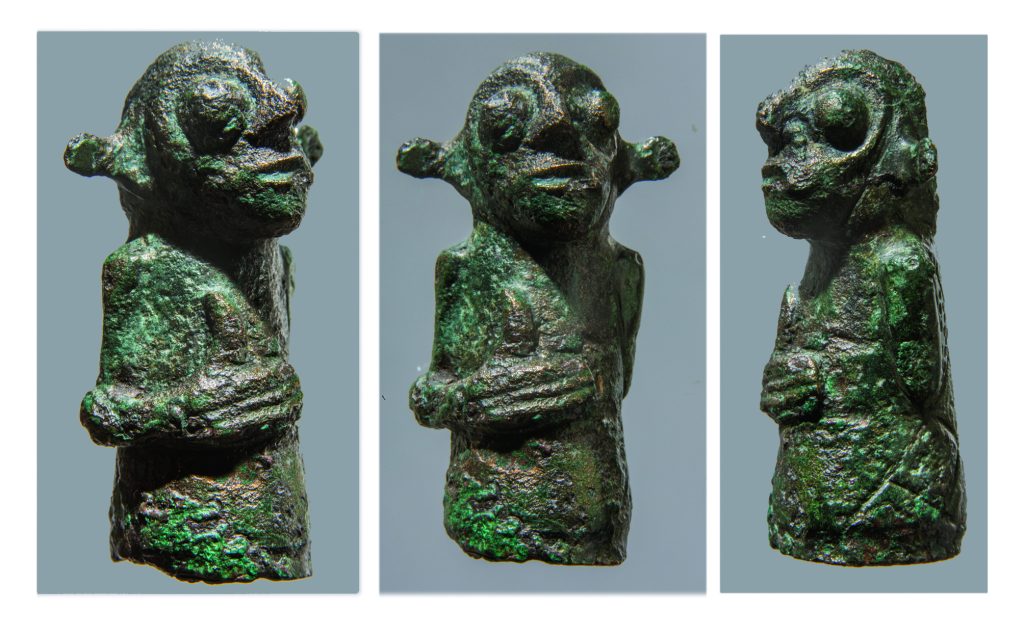
What makes this find so unique is that there are virtually no comparable full-figure anthropomorphic depictions from the La Tène period known in Poland. Certain similarities can be found in the Celtic art of Central and Western Europe, which features recurring motifs such as masks, strongly defined eyes and ears, a schematic silhouette and a symbolic body posture.
The figurine from Krzelków is a symbol of local identity, an archaeological curiosity and the multi-layered history being uncovered across Poland. This small object is a symbol of a bygone world full of connections, beliefs, journeys, rituals and meanings, which we are trying to decipher and which continues to capture the imagination.
Author: Dr Mirosław Furmanek
Editor: Dr Aleksandra Grzegorska
Framework Programme
Work on the programme is ongoing, and a detailed version will be released in stages in the run-up to the event.
Book of Abstracts
The book of abstracts will be available shortly
Accompanying events and competitions
The „Atlas of Polish Archaeology” exhibition” This is an outdoor exhibition accompanying the 2nd Congress of Polish Archaeology, the aim of which is to present contemporary archaeology as a dynamic and diverse academic discipline. The exhibition takes the form of a map showcasing locations across Poland where archaeological activities are carried out – ranging from scientific research and the conservation of historic monuments to museum work and public outreach. The exhibition has been organised in collaboration with public, academic and private institutions to jointly demonstrate the scale and significance of archaeology in the study and conservation of cultural heritage. It offers an insight into the day-to-day work of archaeologists, emphasising that their work involves not only spectacular discoveries but, above all, systematic research and collaboration between numerous centres. Following the Congress, the exhibition will tour various cities across Poland, with a particular focus on regions active in archaeological research.
PMA Children’s Day Archaeology Picnic This event is aimed at our youngest keen adventurers. The picnic will take place on the grounds of the State Archaeological Museum. More details to follow shortly.
Art competition A competition for art school pupils to design the II KAP logo. More details to follow shortly.
Open-air cinema This event is for anyone interested in archaeology and its portrayal in popular culture. The screenings will take place in the evenings of the second and third days of the congress in the area around the Faculty of Archaeology at the University of Warsaw. More details to follow shortly.
Congress Studio Hosted by the „Poza Kontekstem” Channel Team, this is a space for conversations, meetings and live coverage of the most important events. The programme will feature interviews with archaeologists, experts and conference participants, live streaming of events, and a look at archaeology from a completely new perspective. „Poza Kontekstem” combines science, passion and modern media, creating a space where history meets the contemporary narrative.”
Archaeological Sensations 2016–2026 This is a special edition of the ‘Living Archaeology’ poll, organised for the Polish Archaeology Congress, summarising the most significant archaeological discoveries and projects from 2016 to 2026. The event will recognise the most interesting achievements in Polish archaeology – both those carried out in Poland and those undertaken by Polish teams abroad.
The 2nd Congress of Polish Archaeology is not only a series of panel discussions and academic presentations, but also a unique opportunity to learn about the latest technological and technical innovations in modern archaeology.
We aim to create a professional platform for companies offering modern technological solutions, as well as for teams and institutions that work closely with archaeologists, providing specialist services and supplying advanced equipment. Taking part in the Congress is an excellent opportunity to showcase your capabilities, innovative tools and their practical applications in research and heritage conservation.
This tab will be updated regularly with a list of partners and descriptions of the available stands.
Become an exhibitor today! We warmly invite all individuals, companies and research teams interested in showcasing their offerings and setting up an exhibition stand at the 2nd Congress of Polish Archaeology to get in touch.
Please email us for details on the terms and conditions of participation and how to book a space: KAP27@uw.edu.pl”
Registration
Rules and deadlines for submitting proposals for Thematic Sessions
We invite you to submit proposals for themed sessions as part of The 2nd Congress of Polish Archaeology, dedicated to issues in Polish archaeology and research conducted by Polish archaeologists. We invite all archaeologists and specialists collaborating with Polish archaeological missions and carrying out Polish research projects to take part in the Congress, regardless of their nationality.
The conference will take place as an in-person event in Warsaw from 1 to 4 June 2027 at the University of Warsaw’s Central Campus. We are keen for it to be not only a forum for presenting research findings and discussing issues in contemporary Polish archaeology, but also a space for the archaeological community to come together, exchange experiences and forge new collaborations. For this reason, we expect participants and speakers to attend in person.
A session must be submitted by a team of at least two organisers representing different organisations or institutions. The organising team may consist of up to 10 people. The form must include the full name, affiliation and email address of all organisers. The submission should include the title of the session (up to 150 characters) and a short description or abstract of the session (up to 250 words). At the stage of submitting a session proposal, it is not necessary to specify particular papers or presenters. Sessions may be conducted in Polish or English. If the proposal is prepared entirely in English, we will assume that the session will be conducted in that language.
Once a session has been approved by the Organising Committee of the 2nd Congress of Polish Archaeology, it will be opened for the submission of paper proposals. Detailed guidelines for the submission of papers will be provided to the organisers of the approved sessions. A session will only take place if at least five papers are submitted. Organisers may also propose a non-standard session format, subject to the approval of the Organising Committee. Session organisers are free to determine the format and duration of individual presentations, subject to the requirement that the session be adapted to the Congress’s overall timetable, including scheduled coffee breaks, lunch breaks and other elements of the programme.
The final decision on whether to include a session in the Congress programme rests with the Organising Committee of the Second Congress of Polish Archaeology.
Deadline for submitting session proposals: 30 September 2026.
The session submission form is provided below.
Timetable
30 September 2026
Deadline for submitting proposals for scientific sessions
31 October 2026
Announcement of the programme for the academic sessions and the start of the call for papers
20 January 2027
Deadline for submitting abstracts
31 March 2027
Deadline for payment of conference fees
Registration
Registration and paper submissions from 31 October
Practical information
Fees
There is a conference fee for attending the Congress.
- Conference fee: 300 zł
- Fee for PhD students/undergraduates: 150 zł
The deadline for payment is 31 March 2027. The conference fee can be paid via the registration system once the submitted abstracts have been accepted.
Coti-Conference handles payments and administrative settlements. For enquiries regarding bank transfers, invoices and payment confirmations, please contact us at the address provided office@coti-conference.com
Venue
The 2nd Congress of Polish Archaeology will take place in Warsaw, on the premises of The Central Campus of the University of Warsaw (26/27 Krakowskie Przedmieście Street). Some of the accompanying events are also scheduled to take place in The State Archaeological Museum in Warsaw (52 Długa Street).
Research sessions, poster sessions, debates and lectures will take place in the building of the former University Library (Stary BUW) on the Central Campus of the University of Warsaw.
The workshops are scheduled to take place in the Faculty of Archaeology building at the University of Warsaw (Central Campus).
The open-air cinema will be held in the car park and green spaces around the Faculty of Archaeology at the University of Warsaw.
The exhibition “Atlas of Polish Archaeology” will be on display at the State Archaeological Museum in Warsaw. It takes about 25 minutes to walk there from the Central Campus, or about 15 minutes by public transport.
The „Children’s Day – PMA” archaeological picnic will take place on the grounds of the Archaeological Museum in Warsaw.
The exact locations of the individual items on the programme have been marked on the map orange.
- The Campus of the Central University of Warsaw (26/27 Krakowskie Przedmieście Street)
- The State Archaeological Museum in Warsaw (52 Długa Street)
Accommodation
There are many hotels and hostels in the area around the University of Warsaw. Marked in purple on the map.
- Motel One Warsaw-Chopin, 38 Tamka Street (a 9-minute walk from the Old BUW building)
- Logos Hotel, 31/33 Wybrzeże Kościuszkowskie (one metro stop from the university, M2 line, Copernicus Science Centre station)
- Flaner Hotel WorldHotels Crafted, 4 Krakowskie Przedmieście (the entrance closest to the Campus is on the side facing the Copernicus monument)
- Hotel Gromada Centrum, 2 Pl. Powstańców Warszawy (a 10-minute walk from the Old BUW building)
- Hotel Teatro, 66 Nowy Świat Street (a 7-minute walk from the Old BUW building)
- Bristol, 42/44 Krakowskie Przedmieście (a 6-minute walk from the Old BUW building)
- Hotel Europejski, Krakowskie Przedmieście 13 (a 6-minute walk from the Old BUW building)
- Hotel Warszawa, 9 Powstańców Warszawy Square (a 13-minute walk from the Old BUW building)
- Ibis Stare Miasto Hotel, Muranowska 2 (a 15-minute walk from the State Archaeological Museum)
- PURO Warsaw Old Town, Canaletta 4 (a 9-minute walk from the State Archaeological Museum)
Transport
Warsaw has a well-developed public transport network, enabling easy travel between the Congress venues. The main venues – the Central Campus of the University of Warsaw (26/27 Krakowskie Przedmieście) and the State Archaeological Museum in Warsaw (52 Długa) – are well connected to the rest of the city.
Both locations are situated near metro stations: the Central Campus is served by the Nowy Świat–Uniwersytet station (line M2), and the Archaeological Museum by the Ratusz Arsenał station (line M1).
The city is served by the metro, trams and buses. The journey between the Campus and the Museum takes around 25 minutes on foot or around 15 minutes by public transport. We recommend using public transport due to the limited number of parking spaces in the city centre (there is no parking available on the Central Campus of the University of Warsaw).
Time-based tickets (20-, 75- and 90-minute) as well as 24-hour and 3-day tickets are available and can be purchased from ticket machines, on board vehicles and via mobile apps.To reach the main entrance to the University of Warsaw’s Central Campus from the Central Station, you can take bus routes 175 and 128 or the metro (M1, changing to the M2 at Świętokrzyska station). Bus 111, amongst others, runs from the University of Warsaw’s Central Campus to the Archaeological Museum.
Detailed information is available on the „Jakdojadę” app and on the Warsaw Public Transport website: https://www.wtp.waw.pl/
Restaurants and bars in the area
We do not provide lunch during the Congress, so we have put together a list of recommended places to eat on the Central Campus and in the immediate vicinity. These are convenient options for breaks between events, as well as for socialising in the evenings.
Polish cuisine (shown in blue on the map):
- Ceprownia (a 4-minute walk from the Old BUW building)
- Zapiecek (an 8-minute walk from the Old BUW building)
- Polskie Pierogi Restaurant (an 11-minute walk from the Old BUW building)
- Zwierciadło Restaurant (at the Flaner Hotel)
- At the Kucharzy’s in the Arsenal (in the building of the State Archaeological Museum)
Vegetarian options (marked in green on the map)
- Falla (a 4-minute walk from the Old BUW building)
- Vege City (a 4-minute walk from the State Archaeological Museum)
- Falafel Beirut (a 4-minute walk from the National Archaeological Museum)
Pizza (shown in black on the map):
- Nonna Pizzeria (a 5-minute walk from the Old BUW building)
- Bottegas – Neapolitan pizza (a 5-minute walk from the Old BUW building)
- La cantina (an 8-minute walk from the Old BUW building)
- Matto – fresh pasta & Roman pizza by the slice (a 10-minute walk from the Old BUW building)
- Pizza Hut Warsaw, Gruba Kaśka (a 2-minute walk from the State Archaeological Museum)
At affordable prices (shown in yellow on the map)
- McDonald’s (an 8-minute walk from the Old BUW building)
- The café in Stary BUW (in the basement of the Stary BUW building)
- The Sahara Café in the Faculty of Archaeology building (on the ground floor)
- The Szafot Canteen at the Faculty of Law and Administration on the University of Warsaw’s Central Campus
- PolitiCook Bistro & Café at the Faculty of Political Science and International Studies, University of Warsaw
The deluxe option (shown in orange on the map):
- Ale Sztuka Restaurant (a 6-minute walk from the Old BUW building)
- Informal Restaurant (a 7-minute walk from the Old BUW building)
Media Accreditations
We warmly invite members of the media to attend the 2nd Congress of Polish Archaeology. The Congress will provide a forum for presenting current research trends, exchanging experiences within the academic community, and discussing the role of archaeology in social life and the preservation of cultural heritage.
Read moreWe invite all journalists, reporters, photographers and online content creators interested in covering the proceedings in their own capacity to apply for free press accreditation.
What does press accreditation entail?
- Full access to all panels, sessions and conference venues.
- The opportunity to arrange one-to-one interviews with key speakers, experts and invited guests.
- Support from the organisational team in authorising interviews and fact-checking
How do I obtain accreditation?
To register your interest in attending the event, please send an email to KAP27@uw.edu.pl, including:
- First name and surname,
- The name of the editorial team/publication,
- Contact details (telephone, email).
Become a Media Sponsor
We invite newspaper, radio and television editorial teams, as well as online news portals, to collaborate with us in raising awareness of contemporary archaeological research and to act as media patrons for the 2nd Congress of Polish Archaeology. We are keen to ensure that the topics discussed during the event are also featured in public debate and made accessible to a wide audience.
Read moreWhat do we offer as part of our partnership?
- The status of Official Media Partner of a prestigious scientific event.
- Assistance with coordinating and arranging exclusive interviews with experts and participants before and during the event.
- Your logo and details of your media outlet in the official conference materials.
We are open to dialogue and would be happy to tailor the terms of our collaboration to the specific nature and profile of your editorial team.
Enquiries and applications:
Please address any proposals for collaboration or enquiries regarding sponsorship directly to the organising team at: KAP27@uw.edu.pl